
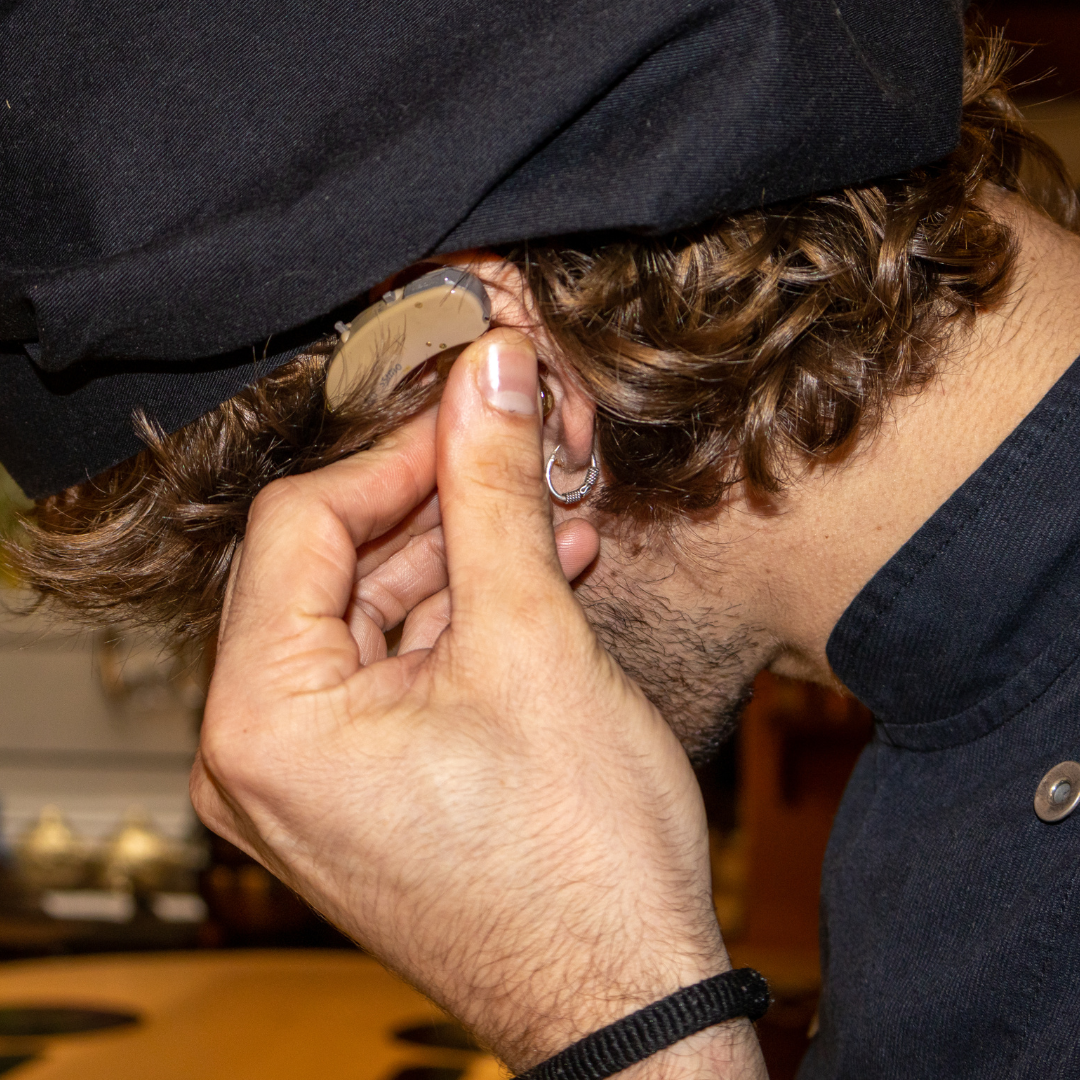
Active restaurant conversations are frequently hard to decipher when surrounding background noise clashes with your hearing. Our practice can evaluate hearing in both quiet and noisy conditions to identify what makes these environments difficult. When we isolate the root mechanism behind your difficult hearing, we guide you toward customized communication solutions.
Why Do I Hear Well in Quiet but Struggle in Restaurants?
In quiet conditions, an optimal signal-to-noise ratio ensures that the desired speaker sounds markedly clearer than surrounding sound. Commercial restaurant spaces present the polar opposite acoustic dynamic. Multiple voices, music, kitchen noise, and reverberation overlap with speech, forcing the ears and brain to work harder to separate the person you want to hear.
This problem can occur with high-frequency hearing loss, auditory-processing difficulty, or age- and noise-related changes. Factors including listening fatigue, poor dining lighting, acoustic distance, and wandering attention make comprehension significantly harder. Some patients pass standard pure-tone evaluations with normal scores yet exhibit substantial impairment during specialized speech-in-noise testing. Communication breakdowns in loud restaurants should be professionally assessed even if one-on-one listening feels uncompromised.
How Audiologists Identify High-Frequency Hearing Loss
We initiate evaluation by exploring challenging acoustic environments, acoustic trauma history, subjective tinnitus, prescription drug profiles, and unilateral ear changes.
Standard pure-tone audiometry gauges the lowest volume thresholds detectable across varying acoustic frequencies via specialized earphones and bone oscillators. Sensorineural high-frequency hearing loss demonstrates an audiometric slope reflecting diminished hearing thresholds as sound frequencies climb. Supplementary assessments routinely include diagnostic tympanometry to analyze middle-ear status alongside word-recognition testing to determine speech clarity.
Standard quiet test booths fail to simulate real-world restaurant noise, making speech-in-noise testing a crucial clinical tool. It evaluates sentence-level speech comprehension as competing background babble increases in volume. Collectively, these evaluations clarify if your challenges relate to raw audibility, phonetic clarity, signal-to-noise processing, or compound factors.
Adult Auditory Processing Disorders and Speech Perception
A diagnosed auditory processing disorder affects how the brain’s auditory cortex analyzes, organizes, and interprets sound. The peripheral auditory system may register sounds within normal limits, yet the brain falters when separating competing acoustic inputs, sorting speech sounds, or tracking fast speech. We systematically verify peripheral hearing health before establishing whether an advanced auditory-processing evaluation or medical referral serves your needs.
Actionable Listening Tips for Noisy Social Settings
Small, intentional adaptations can optimize the clarity of speech reaching your ears and leverage helpful visual speech cues. Prior to dining, choose venues known for lower noise levels or schedule meals during quieter dining hours. Settings constructed with comfortable booths, acoustic ceiling panels, drapery, and carpeted walkways facilitate easier communication than open venues with concrete and glass.
In-venue communication guidelines:
- Reserve a table located well away from kitchen doors, active bar counters, overhead speakers, and banquet groups.
- Position your chair against a perimeter wall to diminish competing auditory chatter behind your head.
- Position yourself directly opposite your companions where direct lighting highlights their facial expressions.
- Keep the distance between speakers as short as comfortably possible.
- Turn your better-hearing ear toward the specific speaker you want to hear most clearly.
- Ask the speaker to rephrase the missed portion instead of repeating everything.
- Validate significant pieces of information directly rather than feigning understanding during dialogue.
- Excuse yourself for a momentary quiet pause when listening exhaustion starts to mount.
- Ask companions to speak clearly at a natural pace.
- Shouting can distort speech and does not necessarily make words easier to understand.
The Best Hearing Devices for Overcoming Restaurant Noise
Selecting the ideal assistive technology depends upon underlying diagnosis, specific acoustic challenges, and verified hearing loss. Professionally fitted hearing aids may use directional microphones, digital noise reduction, and dedicated restaurant programs to emphasize speech from the front and reduce some competing sound. Users should establish realistic expectations because no hearing device can fully eradicate all unwanted ambient speech.
A remote microphone can provide a stronger improvement in the signal-to-noise ratio. Clipped near the speaker’s mouth or set nearby, the transmitter sends voice signals wirelessly to matched hearing aids or a receiver. This reduces the effects of distance and surrounding noise.
Further practical hearing technology options include:
- Portable table microphones for managing multi-speaker dinner conversations
- Hearing-loop telecoils that stream clean audio in loop-equipped establishments
- Smartphone live-captioning platforms providing instant speech-to-text visual support
- Over-the-counter hearables equipped with directional speech-enhancement algorithms
- Acoustic sound-meter apps and dining review directories that score restaurant noise
Our team can compare these systems, verify device compatibility with your hearing aids, and provide comprehensive training on their use.
Clinical Audiology Care for Hearing in Complex Noise
Clinical hearing evaluations progress the diagnostic process past the typical assertion that hearing is adequate in quiet. We assess the specific acoustic settings, speaker dynamics, and volume levels that disrupt your hearing to administer targeted evaluations. The assessment may include pure-tone thresholds, middle-ear testing, word recognition, and speech-in-noise measures. Auditory-processing testing may be considered when the history and initial results support it.
Abrupt auditory reductions, unilateral hearing shifts, or rapid functional deterioration require prompt assessment by an ear, nose, and throat physician. Comprehensive clinical care targets the physiological roots of hearing difficulties rather than simply writing them off as bad restaurant acoustics.
Request an Audiology and Hearing Evaluation Today
If dining in loud spaces leaves you feeling isolated, fatigued, or guessing at missed speech, contact us to schedule a thorough hearing evaluation. Our clinical team will determine the best strategies to improve your hearing in noisy environments through custom hearing-aid programming, remote microphones, or targeted auditory rehabilitation.
Contact our practice today to book your consultation and take a decisive step toward reconnecting in social settings.